Showing posts with label communities. Show all posts

Monday, July 6, 2009

A Thousand Points of Light

Boots
Results! Why, man, I have gotten a lot of results. I know several thousand things that won't work. — Thomas A. Edison


In one of the photography forums I so frequently haunt, a new photographer threw out the age old existential question: "What makes a better photo, film or digital? Discuss." Yikes. Let's just lob the Holy Hand Grenade of Photographic Antioch into our midst and see what carnage we can make!

Ok, it really wasn't that bad. The responses ranged from the obvious of "The photographer" to "it depends on what you're shooting and it's intended use." But the one that caught my eye was the guy who said:

"I shoot both. I do nature with film as I love the whole process but shoot people with digital due to ease of use and most of my shoots with people are typically upward of 1000 - 2000 photos which would be ungodly expensive with film."


I've never really focused on shooting film, but I do understand the expense of it. What I question about his statement is the "1000 - 2000 photos" per shoot with his digital camera. And I have to ask: why? Why would you want to do that, especially for people? Is there something I'm missing here?

I get that there's a desire to create the perfect photo. I really get that. But what is it about digital that makes people think shooting 1000+ photos will get them perfection? Don't get me wrong, there's probably a time and place for it. But really, is that needed all the time? I wonder if people's photos would improve a notch or two if they stopped taking the shotgun approach to their art (or work) and thought a bit about what exactly they were trying to create.

From what I've encountered, some photographers look at digital as the panacea of recording media. I get the sense that these photogs just snap and snap with wild abandon because, hey, it's digital ... it's free! But that's not entirely true. What you've gained in saved film processing costs, you've now lost due to increased time dealing with more photos during post. You're now saving large amounts of data off so your archiving costs increase. There's a larger wear-and-tear factor on your camera. You may or may not care about any of these things.

Now, I'm guilty of doing this on occasion, taking photo after photo of the exact same pose or moment ... or maybe even slightly altering it to see if that changes the dynamic of the content. But ... does this really help me, as a photographer? I realize I can't shoot every thing I see (well, I can, but I won't). I'm going to miss some things. That's just the law of averages.

But, thousands of images at a sitting? Sounds like a bit much to me.

As for the whole digital vs. film debate? That rages on.

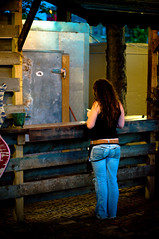
The model above is Scarlet. We were trying different things in the studio. This was my third attempt at this setup. I tried a few times and moved on when I thought I wasn't getting it. Lucky me, it turned out.

Sunday, March 29, 2009

Austin Hangouts

Every Thursday I go to hangout with friends after work. Nothing fancy, just a group that likes to sit down, have some dinner, maybe some coffee, and bullshit for a few hours. Invariably, we all tend to haunt the same dives in Austin for our merriment. Figured I'd at least share some of the better places to go kick around.

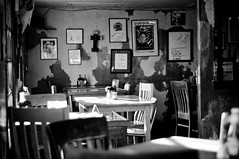
Taking ordersSpiderhouse: one of my local haunts for the last few years. Spiderhouse is rather ... eclectic. Even for a coffee house. Spiderhouse wasn't so much designed as organically grown. Most of the seating is outside either under the porch awning, out on the brick patio, or under the gigantic pecan trees out back. They food is ok. It's mostly vegetarian. Not particularly my thing. But I don't go there for the food, I go there for the occasional good DJ playing while we're relaxing with friends, the decent cup of hot chocolate or apple cider when it's cold, or the pint or two of Liveoak Heffe that's needed when it's blazingly hot out.

Peeling wall paperRuby's BBQ: Ruby's is a stone's through from Spiderhouse. If you're a meatasaurus rex and you're craving meat, it's the place to go if you're up near campus. Another one of Austin's hole-in-the-walls, the place looks like it's about to fall apart. The tiny one-toilet men's room is covered in graffiti and you have to squeeze your fat ass into the door because it's just so damn tight. But the staff is good, the brisket is better, and the cobbler ... pretty damned tasty.

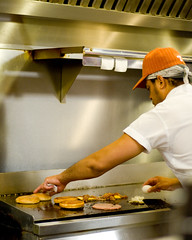
Sometimes you have to break an egg to make a sandwichDirty Martin's: I found out about this place a few months back. If you could throw a stone and hit Ruby's from Spiderhouse, you could hit Dirty Martin's with a bow and arrow ("I fire an arrow into the air and where it lands I know not ... ooooh! damn, it hit Dirty's"). Yet another greasy spoon in Austin. If you have a heart condition, this is probably not the place for you. Serving one of the best quadruple bypasses in the city, Dirty's is the place to go for hamburgers and fries. This is one of the line cooks. I never caught his name, but his expressions are hilarious when you catch him listening to conversations. Nice guy. Sit at the bar if you can. One of the more classic diner feels in Austin. Oh, and the milkshakes aren't half-bad either.

Friday, April 11, 2008

Communities

One of the things that I've been big on lately is communities. Communities for geeks, communities for photographers, communities for just random social coffee drinking. You know, just groups of people getting together for no other reason than having a common passion for something beautiful.

Today was the meetup of the Austin chapter of ASMP. ASMP is the American Society of Media Photographers. A few of the local pros and a handful of the amateurs were there, including Kirk Tuck and Jay B. Sauceda. It's fascinating to listen to these guys talk so matter-of-factly about photography.

So, this morning, we're all sitting around the table BSing and Kirk brings up a story about one of his friends (who's a psychiatrist by trade ... we'll call him Bob because I didn't catch his name) who's doing a shoot with some models around a pool for some company. Kirk happened to be there and was talking to Bob as the shoot was wrapping up. Kirk asked if Bob remembered to get the model releases signed.

"Model releases?"

Oy. So, Kirk ran off to get a stack of his blank releases to loan Bob and made sure that everyone shot signed them. Later, Bob was in discussions with the hiring company about the job. We learned that Bob had taken the job on a verbal agreement. Double oy! Well, during the discussion with the company, they basically stated, "We paid you, we want all the rights and there's nothing you can do about it. We'll use the photos however we want." They appeared to be in a position of power. With no written contract it looked like Bob was up a creek.

"But, you don't have the model releases. I do."

Without those releases, the photos couldn't be used commercially. The tone of the meeting changed immediately after that into one where the company was more agreeable to negotiation. Bob had his trump card in the model releases.

This story was quite eye-opening. I can't say that I'm very savvy on the business side of photography (but I'm getting there!) and I'm learning more everyday. But, the story reminded me of how important it was to do two simple things: always have a written contract and always get a release for the photo. What's even more amazing about this story is that, had there not been someone who had previously gone through this to tell the story to others, I'm sure I would have encountered the same situation at some point in my budding photography career.

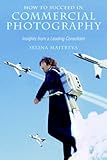
While there, people were passing around a book, How to Succeed in Commercial Photography: Insights from a Leading Consultant. It's apparently one of the best books out there dealing with commercial photography. I think I'll be getting it soon. I didn't get long to look at it ... mostly enough time to take a picture of the ISBN for later. But, it certainly looked short and too the point.